Every claim connects to a case, a chapter or an operating pattern.
This is the proof layer for the site. No invented metrics and no badge clouds — the useful proof is what kind of system was owned, repaired, built or operated, and where you can read the detail.
Aroko, custom CRM/email product, technical teams, client delivery, contracts and support.
HubSpot workflows, source fields, lifecycle stages, handoffs, reporting and governance.
GTM, GA4, events, UTMs, CRM handoff checks, BI joins and platform conversion quality.
Store architecture, product feeds, order flow, ERP handoff, stock and fulfillment visibility.
GS1-related web platforms, catalog discipline, barcode/standards context and operational data quality.
Tavazo Europe
full system launchSoftware/e-commerce architecture, design and development, launch advertising, ERP installation and warehouse process automation.
Inspect proof →Standards + dataGS1
2018-2019National standards context: barcode-related platforms, catalog discipline, web infrastructure, campaign planning and data quality.
Inspect proof →Founder + softwareAroko Tech Pioneers
2011-2019Software delivery teams, contracts, support, custom CRM and email-marketing product thinking from the operator side.
Inspect proof →CRM + reportingPlunet
2022-2025HubSpot, lifecycle automation, data pipelines, GA4/GTM, Looker Studio and reporting governance in a Berlin B2B software context.
Inspect proof →PLG growth systemNinox Software
2025-nowPaid growth architecture, tracking foundations, product signals, CRM quality and BI reporting connected past signup.
Inspect proof →Problem → build → operating output.
Sanitized by design: systems and outputs described honestly, without confidential metrics or invented numbers. Filter by type, or click any card to expand the full structure.
Paid growth architecture for a platform launch & PLG shift
A German low-code SaaS moving from trial-based acquisition to freemium — needing a paid system that could prove itself past the signup.
New product, new motion: multiple ICPs, multiple channels, and a freemium funnel where the conversion that matters happens weeks after the click.
Full campaign architecture across ICPs and funnel stages — LinkedIn, Google Search & Demand Gen, Reddit, G2, Capterra — with UTM governance, stage-specific landing pages, and a layered measurement model connecting website intent, product signals, CRM quality and BI reporting.
One documented paid system: every campaign traceable from impression to revenue-quality outcome, product signals feeding paid optimization, and reporting the leadership team runs weekly.
GTM/GA4 rebuild after a website migration
A site migration quietly broke the tracking foundation — conversions misfired, platforms optimized on noise.
Post-migration: events double-firing or missing, conversion goals pointing at dead URLs, ad platforms and analytics disagreeing badly enough that nobody trusted any number.
Full event taxonomy rebuilt in GTM/GA4: diagnostic events, verified conversion goals, platform alignment, SPA-safe triggers, and reconciliation checks between platforms and the CRM.
A tracking layer the whole funnel could stand on — verified event-by-event, documented, and stable enough to train bidding on real outcomes again.
Fixing the CRM handoff where attribution died
Landing pages had UTMs; the CRM had "direct". The leak sat exactly at the click-to-contact handoff.
Contacts created through API and cross-subdomain paths arrived with no source data; first-touch fields were overwritten on later form fills. Marketing couldn't defend spend.
Source-preserving handoff: first-touch UTM properties written once per contact, custom marketing-touch events synced from product analytics, and a shared user key across CRM, product and warehouse.
Pipeline finally carrying its origin: campaign-level attribution in the CRM, "unknown" collapsed to a residual, and channel decisions made on lineage instead of folklore.
Central warehouse reporting for a marketing team
Tool-by-tool reporting meant hours of manual exports and numbers that never matched between meetings.
CRM, ads, analytics and web data lived in silos; monthly reporting was a copy-paste ritual and every stakeholder kept a private spreadsheet version of the truth.
Data pipelines and automated syncing between the marketing tools, a central warehouse as the single reporting source, and Looker Studio dashboards built on defined, documented metrics.
Standing dashboards replaced the export ritual: one definition per metric, one place to look, and marketing KPIs reported monthly without archaeology.
Store, feed and campaign system for a fashion brand
One connected commerce system: the platform, the product feeds, the paid engine and the analysis loop.
A growing fashion brand with the classic split-vendor mess: a store, an agency, a feed problem — and nobody owning the whole chain from product data to purchase.
Built the e-commerce site end to end (payments, shipping gateways, variation logic, live chat), Merchant Center feeds with optimization rules, and full-funnel Google + Facebook campaigns with behavioral analysis via analytics, heatmaps and session recordings.
One owner, one system: product changes flowed to feeds, feeds to campaigns, campaigns to measured purchases — with merchandising and sales actions executed inside the same loop.
Software, e-commerce, ERP, warehouse automation and launch marketing
A broader commercial build: not only a website or ads, but the operating system around a European commerce launch.
A launch needed more than a storefront: software and e-commerce architecture, design and development, operational handoffs, ERP setup, warehouse process automation, advertising and reporting had to work together.
Architected and built the commercial layer across software, e-commerce UX, operational workflows, ERP installation, warehouse automation logic, launch advertising and measurement.
A connected launch system: customer-facing commerce, internal operations, inventory/warehouse process, marketing execution and reporting designed as one system rather than separate vendor tasks.
Multi-client lead-generation systems for the DACH market
Ads, tracking, CRM automation and the websites themselves — built and proven across SMB clients.
SMBs needing pipelines, not campaigns: each with different offers, budgets and sales processes, none with in-house marketing operations.
Per-client lead-gen stacks: Google Ads with GTM conversion tracking, HubSpot automation (sequences, segmentation, lifecycle), omnichannel LinkedIn outreach with conditional logic, plus conversion-focused WordPress builds.
Repeatable systems handed to clients as documented operating assets: trackable spend, automated follow-up, and websites that carried their own conversion weight.
Confidentiality note: client-specific revenue figures and internal metrics are deliberately excluded. References and deeper detail available in conversation.
Read the work by operating problem, not by logo status.
These pages explain the role, system angle, stack and relevant buyer meaning. They are experience chapters, not endorsements.
Ninox Software
B2B SaaS PLG growth system
Open chapter Jan 2022 — Mar 2025Plunet
CRM, automation, reporting & performance marketing
Open chapter Sep 2021 — Oct 2022LeadChamps
DACH SMB lead-generation systems
Open chapter Mar 2020 — Oct 2021Alexander Gardi
Fashion e-commerce performance & platform system
Open chapter Aug 2018 — Nov 2019GS1
Digital infrastructure, web platforms & growth marketing
Open chapter Aug 2011 — Nov 2019Aroko Tech Pioneers
Founder/operator & software delivery system
Open chapter May 2016 — Sep 2018Novintandis
B2B automation, affiliate & analytics systems
Open chapterSome proof should be visual, because the work itself is visual and operational.
Sanitized references based on real working files: command centers, GTM files, launch wireframes and search/reporting tools. They prove the type of system thinking behind the work, without exposing private customer data.
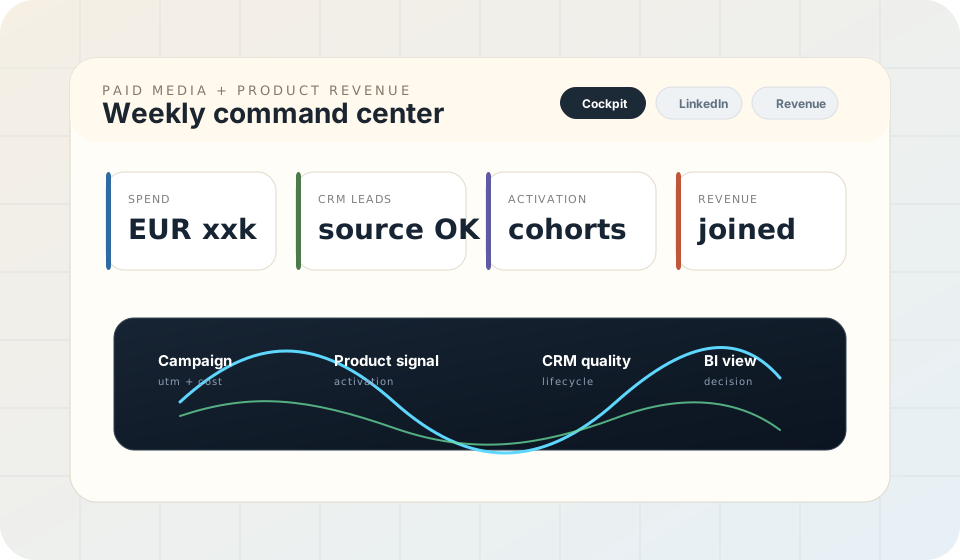
Paid media, product signals, CRM quality and revenue in one weekly view.
Based on a paid-to-revenue reporting artifact: campaign spend, product activation, CRM quality and BI reporting are treated as one operating layer instead of four disconnected reports.
Every project should leave behind an operating asset.
A useful engagement does not end as “we ran campaigns” or “we made a dashboard.” It leaves behind a map, definitions, handoffs, implementation logic and a decision rhythm.
Map
What exists, what breaks, which owner touches the next step.
Build
Pages, flows, automations, events, dashboards or operating documents.
Govern
Definitions, source logic, QA checks and ownership rules.
Operate
Weekly decision loops and prioritized improvements.
Your situation probably rhymes with one of these. Let's find out which.
Use the service recommenderEvidence first, scope second.
Run the free audit against your own stack, open a company chapter, or send the system problem directly. The right route depends on what is already built and what can be trusted.